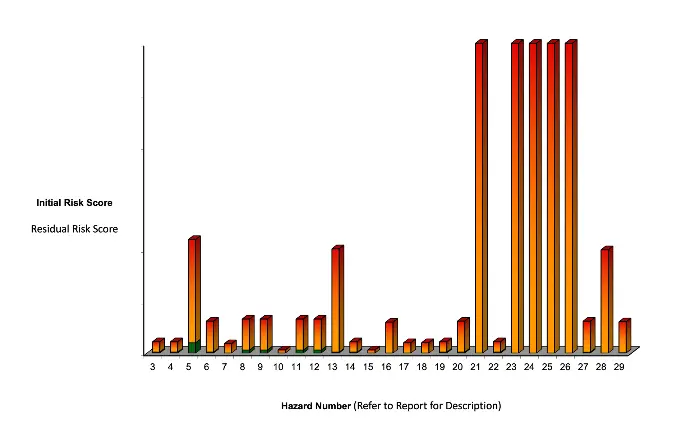
| 1 | Crash / collision | Driver injury | None | Health and Safety | 2 -20 fatalities. Short or long term health exposures leading to significant irreversible human health effects to >50 persons. | 100 | Uncertainty | Possible | 1 | 100 | Reduced speed - controlled by nominated engine and limited to 10hp or less. Driver PPE including long sleeves, helmet and gloves. | Moderate irreversible disability or impairment (<30% of body) to one or more persons. Days lost due to injury. | 10 | Unlikely | 0.3 | 3.00 | 97.00 | 97.00% | Cyclekarts design guidelines to nominate maximum engine / motor power to limit max speed to safer level. Events are non-competetive. No awards given for event placings. No awards given for drivers series or similar competition. Minimum mandatory PPE to be included in CCA guidelines and overall event management strategy including event regulations and drivers meeting. NOTE neck braces are not mandated, as evidence to support injury reduction when used in kart racing shows that neck braces actually contribute to some neck injuries. Neck brace use is therefore down to driver preference. | | |
| 2 | Crash / collision | Pedestrian injury | None | Health and Safety | 2 -20 fatalities. Short or long term health exposures leading to significant irreversible human health effects to >50 persons. | 100 | Uncertainty | Possible | 1 | 100 | Ensure adequare segregation between CKs and pedestrians. Ensure adequate pedestrian management. All on-track volunteers to have minimum track marshall training | Moderate irreversible disability or impairment (<30% of body) to one or more persons. Days lost due to injury. | 10 | Unlikely | 0.3 | 3.00 | 97.00 | 97.00% | Event management plan to include adequare segregation between public and track. Physical barriers should be considered for public events. ALL on track volunteers must have at minmum marshall training. | | |
| 3 | Driver crashing into fixed object | Driver losing control / Leaving track | #1 Driver PPE #2 Pedestrian segregation | Health and Safety | Moderate irreversible disability or impairment (<30% of body) to one or more persons. Days lost due to injury. | 10 | Uncertainty | Possible | 1 | 10 | Track route planning to avoid fixed objects where possible. Where fixed objects remain, soft barriers to be erected. | Moderate irreversible disability or impairment (<30% of body) to one or more persons. Days lost due to injury. | 10 | Rare | 0.1 | 1.00 | 9.00 | 90.00% | Ensure that event management plan surveys course for fixed hazards | | |
| 4 | Driver Competence | Driver crashing into other driver / cyclekart / spectator / fixed object | #1 Driver PPE #2 Pedestrian segregation | Health and Safety | Moderate irreversible disability or impairment (<30% of body) to one or more persons. Days lost due to injury. | 10 | Uncertainty | Possible | 1 | 10 | Driver competence training and assessment | Moderate irreversible disability or impairment (<30% of body) to one or more persons. Days lost due to injury. | 10 | Rare | 0.1 | 1.00 | 9.00 | 90.00% | Managemenet of driver competence via licensing and training scheme. Behaviour expectations reinforced with drivers meetings. Marshals to monitor for drivers behaviour. Penalisation for dangerous driving / at-risk behaviour (Sent to pits and potential suspension cancellation of license / membership for repeated or serious breaches) | | |
| 5 | Hooning | Driver crashing into other driver / cyclekart / spectator / fixed object. Intentional disregard for safety protocols | None | Health and Safety | 2 -20 fatalities. Short or long term health exposures leading to significant irreversible human health effects to >50 persons. | 100 | Uncertainty | Possible | 1 | 100 | Driver competence training and assessment. On-track behaviour monitoring by Marshals. Penalisation for Hoon behaviour. | 2 -20 fatalities. Short or long term health exposures leading to significant irreversible human health effects to >50 persons. | 100 | Rare | 0.1 | 10.00 | 90.00 | 90.00% | Residual severity is unchanged, only likelihood is reduced by controls, leading to high residual risk score. Multiple controls are required to ensure that risk remains controlled in event of singular control failure. Managemenet of driver competence via licensing and training scheme. Behaviour expectations reinforced with drivers meetings. Marshals to monitor for drivers behaviour. Penalisation for dangerous driving / at-risk behaviour (Sent to pits and potential suspension cancellation of license / membership for repeated or serious breaches) | | |
| 6 | Engine starting / pit activities / exiting running cyclekart | Runaway Cyclekart | None | Health and Safety | Moderate irreversible disability or impairment (<30% of body) to one or more persons. Days lost due to injury. | 10 | Uncertainty | Likely | 3 | 30 | Cyclekarts to be fitted with handbrake. handbrake to be used when starting kart. In absence of handbrake, driver to be seated in kart when kart engine started / running. Engine must be shut off before exiting cyclekart | Moderate irreversible disability or impairment (<30% of body) to one or more persons. Days lost due to injury. | 10 | Rare | 0.1 | 1.00 | 29.00 | 96.67% | Cyclekart construction guidelines to include handbrake requirement. Scrutineering checklist to include handbrake check | | |
| 7 | Noise | Nuisance | None | Reputation | Adverse local public or media attention and complaints. Heightened scrutiny from regulator. Asset reputation is adversely affected with a small number of people. | 3 | Uncertainty | Likely | 3 | 9 | Ensure that all Cyclekarts meet noise requirments | Public concern restricted to local complaints. Low level interest from local media and/or regulator. | 1 | Rare | 0.1 | 0.10 | 8.90 | 98.89% | Cyclekart construction guidelines to include silencer requirement | | |
| 8 | Emergency Access | Delayed treatment due to emergecy vehicle access restriction | Unspecified | Health and Safety | Single fatality. Severe irreversible disability or impairment (>30% of body) to one or more persons. | 30 | Uncertainty | Possible | 1 | 30 | Ensure that adequate access is provided and maintained | Single fatality. Severe irreversible disability or impairment (>30% of body) to one or more persons. | 30 | Rare | 0.1 | 3.00 | 27.00 | 90.00% | Event management plan to include access audit and parking controls to ensure clearway | | |
| 9 | Parking | Nuisance / reputation. Inhibits emergeny access resulting in delayed treatment | Unspecified | Health and Safety | Single fatality. Severe irreversible disability or impairment (>30% of body) to one or more persons. | 30 | Uncertainty | Possible | 1 | 30 | Ensure adequare parking is provided for vehicles and trailers and that all accessways are adequately managed | Single fatality. Severe irreversible disability or impairment (>30% of body) to one or more persons. | 30 | Rare | 0.1 | 3.00 | 27.00 | 90.00% | Event management paln to include parking study. Adequate / suitable parking management to be implimented | | |
| 10 | Toilets / amenities | Nuisance / health risk | Unspecified | Reputation | Adverse local public or media attention and complaints. Heightened scrutiny from regulator. Asset reputation is adversely affected with a small number of people. | 3 | Uncertainty | Possible | 1 | 3 | Ensure adequate amenities | Public concern restricted to local complaints. Low level interest from local media and/or regulator. | 1 | Rare | 0.1 | 0.10 | 2.90 | 96.67% | Event management plan to include ameneties study. Ameneties to comply with council requirements (headcount:toilet ratio) | | |
| 11 | First aid | Ability to administer first aid | Unspecified | Health and Safety | Single fatality. Severe irreversible disability or impairment (>30% of body) to one or more persons. | 30 | Uncertainty | Possible | 1 | 30 | Ensure first aiders present | Single fatality. Severe irreversible disability or impairment (>30% of body) to one or more persons. | 30 | Rare | 0.1 | 3.00 | 27.00 | 90.00% | Event management plan includes allocated roles for marshals with mandatory first aid training | | |
| 12 | Emergency services availability | Attendance delay for remote or rural events | Unspecified | Health and Safety | Single fatality. Severe irreversible disability or impairment (>30% of body) to one or more persons. | 30 | Uncertainty | Possible | 1 | 30 | Liaison / notification of emergency services | Single fatality. Severe irreversible disability or impairment (>30% of body) to one or more persons. | 30 | Rare | 0.1 | 3.00 | 27.00 | 90.00% | Event management plan includes emergency services notificatiom=n. Lager or remote events may require hiring of St Johns ambulance support | | |
| 13 | Track / venue specific hazards | Loss of control resulting in crash | Unspecified | Health and Safety | 2 -20 fatalities. Short or long term health exposures leading to significant irreversible human health effects to >50 persons. | 100 | Uncertainty | Possible | 1 | 100 | Track check | Moderate irreversible disability or impairment (<30% of body) to one or more persons. Days lost due to injury. | 10 | Rare | 0.1 | 1.00 | 99.00 | 99.00% | Event management plan includes track check. Officials must walk the track. All hazards must be adequately mitigated / controlled. Fixed objects / ingress & egress / track condition / spectator seregation / visibility | | |
| 14 | Mechanical failure of Cyclekart | collision with other CK or spectator | #1 Driver PPE #2 Pedestrian segregation | Health and Safety | Moderate irreversible disability or impairment (<30% of body) to one or more persons. Days lost due to injury. | 10 | Uncertainty | Possible | 1 | 10 | Minimum standard of construction enforced | Moderate irreversible disability or impairment (<30% of body) to one or more persons. Days lost due to injury. | 10 | Rare | 0.1 | 1.00 | 9.00 | 90.00% | Cyclekart construction guidelines to include minimum construction stadnard. Scrutineering checks to validate construction in accordance with guidelines | | |
| 15 | Siognificant Weather Events - Rain - Heat - Cold | Risk of injury | None | Health and Safety | Objective but reversible disability/impairment Medical treatment injury. | 3 | Uncertainty | Possible | 1 | 3 | Shade, water stations, weather monitoring Contingency plan for suspension / reschedule | Low level short-term subjective inconvenience or symptoms. No medical treatment. | 1 | Rare | 0.1 | 0.10 | 2.90 | 96.67% | Pre-event weather checks. Drivers meeting advisory for participants | | |
| 16 | Incomplete indemnity / waivers signed | Legal liability | None | Legal | Major civil litigation. Class actions. | 30 | Uncertainty | Possible | 1 | 30 | Waiver collection at sign-on. Double-check process before drivers run | Low-level legal issue. | 1 | Very Rare | 0.03 | 0.03 | 29.97 | 99.90% | No event shall start unless scrutineering and waivers have been completed. No exceptions!!! Include process in event checklists and reminder in event regulations | | |
| 17 | communications failure between officials | Risk of injury / accident | #1 Driver PPE #2 Pedestrian segregation | Health and Safety | Moderate irreversible disability or impairment (<30% of body) to one or more persons. Days lost due to injury. | 10 | Uncertainty | Possible | 1 | 10 | Backup radios and mobile phones. Test comms before and during event. User of flags / line of sight for marshalls & tack control | Low level short-term subjective inconvenience or symptoms. No medical treatment. | 1 | Rare | 0.1 | 0.10 | 9.90 | 99.00% | Include pre-event and periodic comminications checks / check ins. Adoption of standard track / marshall / flag procedures | | |
| 18 | Negative media/social media post | Reputation / Legal | None | Reputation | Attention from regional media and/or heightened concern by local community. Criticism by community, NGOs or activists. Asset reputation adversely affected. | 10 | Uncertainty | Possible | 1 | 10 | Media/press policy, CCA social media guidelines Committee to approve official posts | Public concern restricted to local complaints. Low level interest from local media and/or regulator. | 1 | Rare | 0.1 | 0.10 | 9.90 | 99.00% | Committee member behavioural guidelines. Official Press policy | | |
| 19 | Poor track surface / debris causes loss of control | Risk of injury | #1 Driver PPE #2 Pedestrian segregation | Health and Safety | Moderate irreversible disability or impairment (<30% of body) to one or more persons. Days lost due to injury. | 10 | Uncertainty | Possible | 1 | 10 | Pre event track check. Event day track check. ALL hazaards / risks to be adequately mitigated | Moderate irreversible disability or impairment (<30% of body) to one or more persons. Days lost due to injury. | 10 | Rare | 0.1 | 1.00 | 9.00 | 90.00% | Residual severity is unchanged, only likelihood is reduced by controls, leading to high residual risk score. Multiple controls are required to ensure that risk remains controlled in event of singular control failure. Event management plan includes track check. Officials must walk the track. All hazards must be adequately mitigated / controlled. In cases where track is deemed dangerous or risks are unable to be adequately controlled, event cancellation should be considered | | |
| 20 | Accident management on track | Risk of cyclekart collision in events of accident / stoppage | #1 Driver PPE #2 Pedestrian segregation | Health and Safety | Single fatality. Severe irreversible disability or impairment (>30% of body) to one or more persons. | 30 | Uncertainty | Possible | 1 | 30 | Adopt standard marshalling procedures. Implimenet standard flag signalling. Reduction in speed + alert drivers to hazard | Moderate irreversible disability or impairment (<30% of body) to one or more persons. Days lost due to injury. | 10 | Rare | 0.1 | 1.00 | 29.00 | 96.67% | Track control management procedures to include marshalling and flag procedures. Formal marshal training. Driver training and drivers meeting to include marshalling and flag procedures. Include within Event regulations. Refresher at drivers meeting | | |
| 21 | Club liability due to driver incompetence | Risk of injury | None | Legal | Hostile takeover, public shareholder discontent resulting in loss of Chairman/CEO/Board, bankruptcy, closure of organisation. | 1000 | Uncertainty | Possible | 1 | 1000 | Driver competence training and management | Low-level legal issue. | 1 | Rare | 0.1 | 0.10 | 999.90 | 99.99% | Driver licensing and competence management. Existing road license holder (non-license holders require competence assessment). Provision of road license number as part of club liicensing. Event participation requires liability waiver / fitness to drive statement (issued in drivers pack) | | |
| 22 | Club liability due to incompetence | Risk of injury | #1 Driver PPE #2 Pedestrian segregation | Health and Safety | Moderate irreversible disability or impairment (<30% of body) to one or more persons. Days lost due to injury. | 10 | Uncertainty | Possible | 1 | 10 | Driver competence training and management | Moderate irreversible disability or impairment (<30% of body) to one or more persons. Days lost due to injury. | 10 | Rare | 0.1 | 1.00 | 9.00 | 90.00% | Contruction guidelines outline Cyclekart specifications. Event participants are all paid members and operate in accordance with guidelines. Cyclekarts are scrutineered to ensure compliance with guidelines | | |
| 23 | Formal Legal Entity | Formal Legal Entity required to be able to deal with insurers / councils / corporate entities | None | Legal | Fines and prosecutions relating to criminal breaches including jail terms and/or being the subject of a royal commission. | 100 | Projects | …could easily be incurred and has generally occurred in similar studies or projects | 3 | 300 | Registration of club as an incorporated association. Registration of club as Registered Australian Body | Low-level legal issue. | 1 | …conceivable, but only in extreme circumstances. | 0.03 | 0.03 | 299.97 | 99.99% | Ensure ongoing registration of club as an incorporated association. Ensure ongoing registration of club as Registered Australian Body | | |
| 24 | Individual liability | Operating as non-incorporated association | None | Legal | Fines and prosecutions relating to criminal breaches including jail terms and/or being the subject of a royal commission. | 100 | Projects | …could easily be incurred and has generally occurred in similar studies or projects | 3 | 300 | Registration of club as an incorporated association. Limits indiviual liability. Registration of club as Registered Australian Body. Allows Australia wide operations | Low-level legal issue. | 1 | …conceivable, but only in extreme circumstances. | 0.03 | 0.03 | 299.97 | 99.99% | Ensure ongoing registration of club as an incorporated association. Ensure ongoing registration of club as Registered Australian Body | | |
| 25 | Club officer or agent behaviour | Club liability due to incompetence / at-risk behaviour | None | Legal | Hostile takeover, public shareholder discontent resulting in loss of Chairman/CEO/Board, bankruptcy, closure of organisation. | 1000 | Projects | …could easily be incurred and has generally occurred in similar studies or projects | 3 | 3000 | Committee nomination review process to ensure that nomniees are suitable for role. Ensure that appropriate checks and balances are implimented in review process | Low-level legal issue. | 1 | …conceivable, but only in extreme circumstances. | 0.03 | 0.03 | 2999.97 | 100.00% | Committee nomination review procedure. Check legal status to hold role (non-bankrupt etc). Review written nomination application to determine suitability (competence / risk appetite). Ensure committee member on-boarding includes roles and responsibilities (document) | | |
| 26 | Unwanted pets / animal interaction | Animals running on to track | None | Health and Safety | Single fatality. Severe irreversible disability or impairment (>30% of body) to one or more persons. | 30 | Uncertainty | Almost Certain | 10 | 300 | Strict pet management policy. All animals to be restrained / kept on lead | Low level short-term subjective inconvenience or symptoms. No medical treatment. | 1 | Very Rare | 0.03 | 0.03 | 299.97 | 99.99% | Event management plan to include animal control. Event regualations to include clear instruction for pet management | | |
| 27 | Refuelling / fuel storage | Risk of Fire / explosion | None | Health and Safety | Single fatality. Severe irreversible disability or impairment (>30% of body) to one or more persons. | 30 | Uncertainty | Possible | 1 | 30 | Cyclekart fuel tanks to be approved type. Fuel stored in approved containers. Pit crew kit to include fire extinguisher. Fuel stored in designated area. No smoking or naked flames | Single fatality. Severe irreversible disability or impairment (>30% of body) to one or more persons. | 30 | Very Rare | 0.03 | 0.90 | 29.10 | 97.00% | Develop fuel handling management plan | | |
| 28 | Exhaust flames / sparks | Risk of grassfire | None | Environment | Unplanned serious or extensive impact (<20 years) on ecosystem or Threatened Species. | 100 | Uncertainty | Possible | 1 | 100 | Management of potential ignition sources when fire danger rating is high. Potential cancellation of event when first risk level is Extreme or catostophic | Unplanned low level environmental impact | 1 | Very Rare | 0.03 | 0.03 | 99.97 | 99.97% | Management of potential ignition sources when risk is high e.g. power tools, exhasut spark arrestor. Inclusion of spark arrestor requirement in construction guidelines. Local fire level rating review as part of event management plan. Potential for event cancellation when fire risk rating is 'extreme'. Additional risk assessment required to ensure event can proceed safely. Event cancellation where fire risk rating is 'Catastrophic'. (AFDRS fire risk level ratings) | | |
| 29 | Track Familiarity | Risk of crash / injury due to driver leaving track | None | Health and Safety | Single fatality. Severe irreversible disability or impairment (>30% of body) to one or more persons. | 30 | Uncertainty | Possible | 1 | 30 | Ensure driver familiarity with track. Conduct track walk or slow drive with pace kart at front to allow drivers to become familiarised with track. | Moderate irreversible disability or impairment (<30% of body) to one or more persons. Days lost due to injury. | 10 | Very Rare | 0.03 | 0.30 | 29.70 | 99.00% | Track walk as part of drivers meeting is ideal as features / dangers / residual risks associated with the track can be highlighted and discussed by all. If track is a purpose build track or similar that is mapped, then a slow familiarisation lap may be more appropriate. This should follow the drivers meeting which should include a review of the track map before departing. | | |